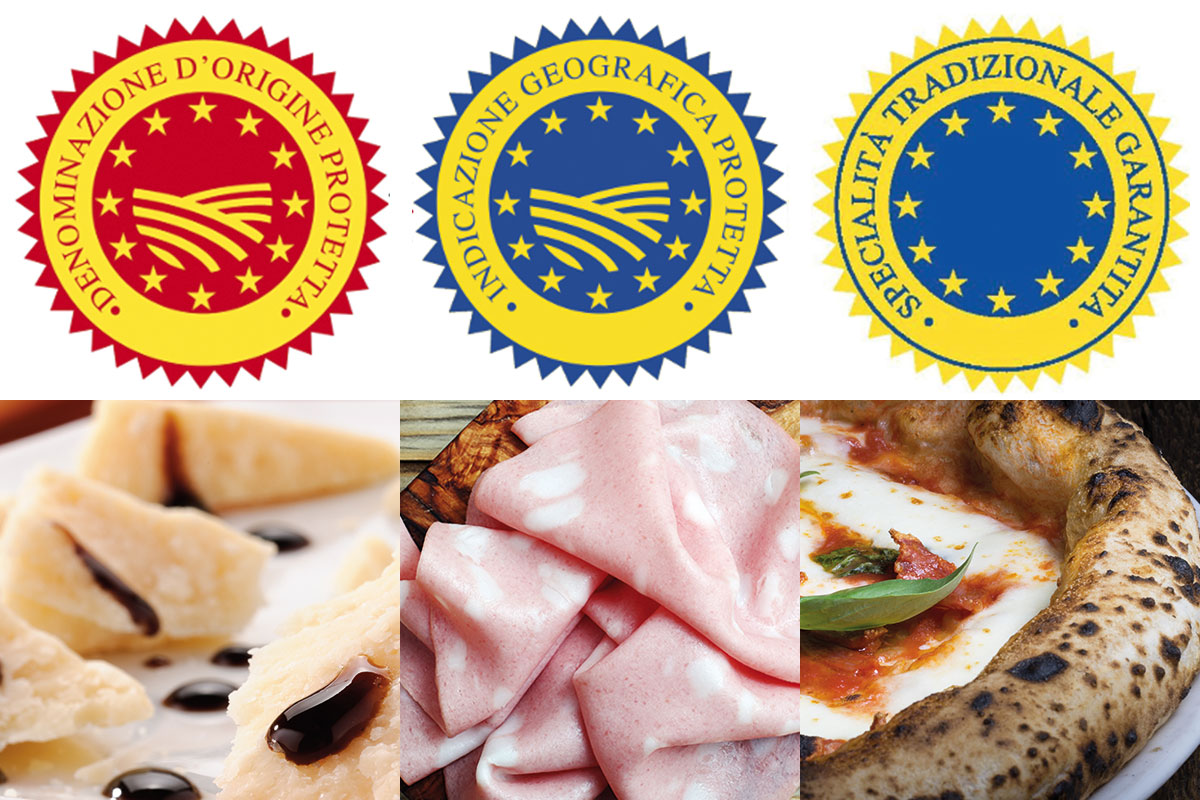
In November 2025, the latest Ismea–Qualivita Report on Italian products was published, offering a detailed snapshot of the state of the country’s so-called “PDO economy”. The data confirm a sector in solid expansion, but also increasingly exposed to geopolitical and market risks.
According to the report, in 2024, the PDO and PGI system reached a production value of €20.7 billion, up 3.5% year on year, accounting for 19% of total national agri-food turnover. Food products were the main driver of growth, with the segment rising 7.7% to exceed €9.6 billion.
For the first time ever, exports surpassed €12 billion, marking an annual increase of 8.2%. This milestone was driven by a “double record”: the food sector exceeded €5 billion in exports for the first time, while wine went beyond €7 billion.
Food exports recorded the strongest growth, reaching €5.15 billion (+12.7% in one year). Double-digit increases were reported for cheeses, fruit and vegetables, cereals, and olive oil. Wine exports also expanded, albeit at a slower pace, rising 5.2% year on year to €7.19 billion.
Overall exports grew both within the EU (+5.9%) and in non-EU markets (+10.4%). The United States confirmed its position as the leading destination market, absorbing more than one-sixth of Italian PDO and PGI exports, equal to 22% of the total.
THE SHADOWS: TARIFFS AND ITALIAN SOUNDING
Despite the positive macro picture, the report highlights significant challenges. By October 2025, 48% of supply chains reported negative effects from US tariffs, while 61% of Protection Consortia had launched market diversification strategies. However, only one in three expects tariffs to have a significant long-term impact.
Adding further instability is the phenomenon of Italian Sounding, estimated to be worth over €100 billion per year. Beyond distorting the global perception of Italian cuisine — which has been recognised as UNESCO Intangible Cultural Heritage since last December, within a global market exceeding €228 billion — Italian Sounding damages exports and confuses consumers. Around 600,000 restaurants worldwide describe themselves as “Italian”, yet only a limited share meet authentic standards.
THE VOICE OF CONSORTIA
Alessandro Utini, President of the Consortium for the Protection of Prosciutto di Parma PDO, explained that the introduction of tariffs, combined with the depreciation of the US dollar, has had a significant impact on the sector. In 2024 (pre-tariffs), the United States was Parma ham’s leading market, with 800,000 hams exported, representing one-third of total exports, for a value of €100 million. “In the three months following the entry into force of the tariffs, exports fell by around 20%,” Utini said, “although the situation now appears to have stabilised.”
The Consortium’s strategy focuses on strengthening product education activities in the US, to ensure consumers continue to choose PDO Prosciutto di Parma despite higher prices, while also boosting sales in emerging markets such as Eastern Europe.
Gianni Maoddi, President of the Pecorino Romano PDO Consortium, stressed that “for Pecorino Romano, the new 15% tariff has directly affected competitiveness, as the US accounts for around 40% of total exports, equivalent to approximately $170 million per year.” To address the crisis, several measures have been implemented. However, Maoddi stressed that “a coordinated response is essential to protect the entire sheep dairy supply chain, which involves tens of thousands of families across Italy.”