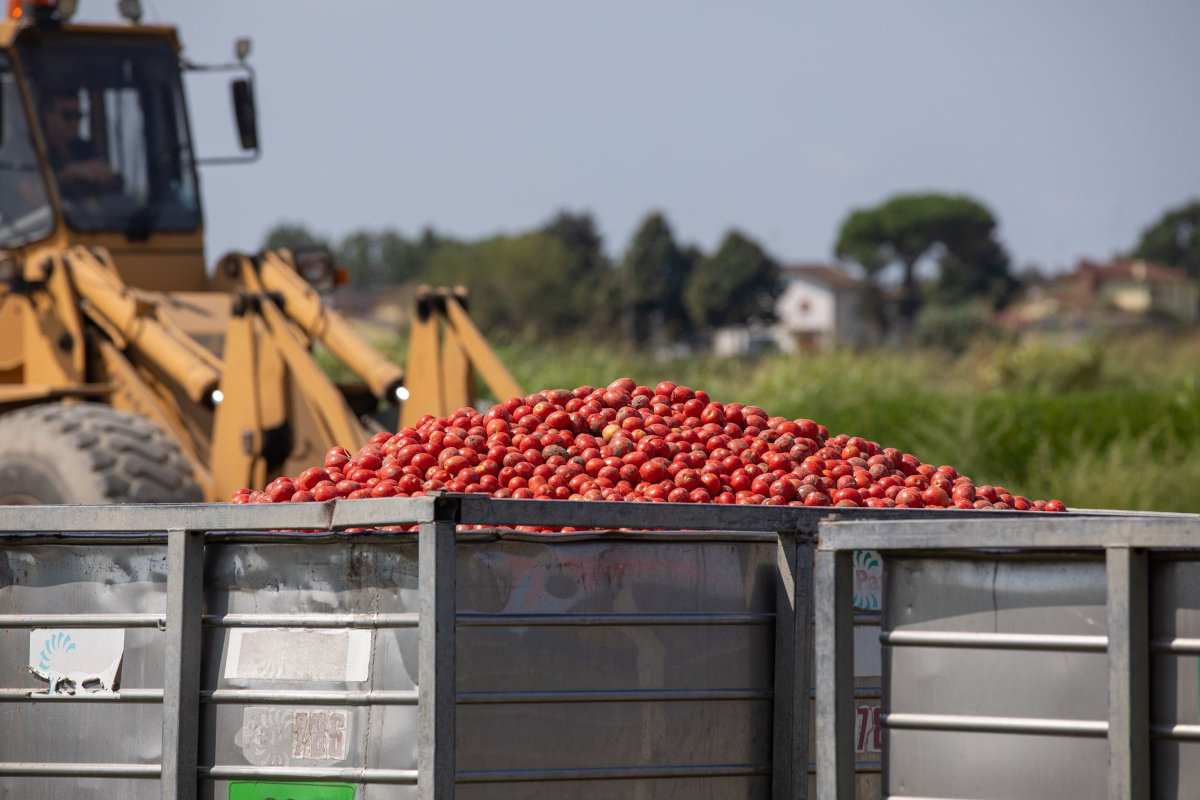
Competitiveness is hanging in the balance for Italy’s processed tomato industry. This was the key message emerging in Naples during Anicav’s public assembly—the thirteenth edition of Il Filo Rosso del Pomodoro—where institutions, industry leaders, and agricultural representatives took stock of the 2025 campaign. A long and complex processing season, coupled with structural criticalities, is weighing on efficiency and profitability across the supply chain.
Central to the discussion was a new report by The European House–Ambrosetti, and the keynote speech from Italy’s Agriculture Minister Francesco Lollobrigida, who described the sector as “a pillar of Italian agri-food.”
Anicav President Marco Serafini reaffirmed the resilience of Made in Italy production but issued a clear warning about competitive pressures. “New producing countries are entering the market relying on low prices. They cannot guarantee our quality, but they risk subtracting significant market shares, especially in the long term,” he said.
For Anicav, boosting efficiency requires coordinated action on three fronts: water-resource management, EU limits on plant-protection products and fertilisers, and the impact of the Emissions Trading System (ETS), which the association considers particularly punitive for a seasonal sector like processed tomatoes.
General Director Giovanni De Angelis stressed the need for a more structured dialogue between farmers and processors. “The interprofessional system must be strengthened and reformed, especially in the Centre-South of Italy, where 32 producers’ organisations are active—compared to just 12 in the North—resulting in weaker bargaining power and limited planning capacity,” he noted.
The price of tomatoes paid to Italian farmers remains the highest in the world. It has increased by 50% in four years, with peaks of +67% in the South, squeezing industry margins already under pressure from the retail sector.
INTERNAL FACTORS: HIGH COSTS, FRAGMENTED OPS, UNDER-SCALED PLANTS
Anicav highlighted several structural challenges:
- Weak governance and producers’ organisations that are “too small,” especially in the Centre-South.
- Supply-chain tensions driven by high raw-material costs.
- Fragmented industrial plants in Southern regions, unable to benefit from economies of scale.
EXTERNAL FACTORS: EU RULES, CLIMATE, U.S. TARIFFS
External pressures further undermine competitiveness:
- EU restrictions on agrochemicals and fertilisers, which reduce yields; insufficient crop protection could jeopardise over 80% of production.
- The ETS system which applies to no other food sector in Italy.
- Water shortages and infrastructure gaps, with sharper disparities between North and South. The agriculture ministry announced new investments and a strategic link between the Occhito (Foggia) and Liscione (Campobasso) dams.
- International competition and U.S. tariffs, with duties rising from 6–12% to 15% across all products.
THE SECTOR IN NUMBERS
- 2025 production: 5.8 million tonnes (–10% vs. planned).
- Italy returns to second place globally in tomato processing, behind the U.S. and ahead of China.
- Italy accounts for 14.4% of worldwide production and 53.8% of Europe’s processed output.
- 2024 exports: +6.5% in volume, +3.8% in value.
- 2025 H1 exports: –3.6% in volume, –10.7% in value, largely due to U.S. tariffs.
- Top markets: Germany, UK, U.S., Japan, Australia.
- Domestic consumption: stable but slightly declining (–0.4% volume, –0.5% value).
Most consumed product categories:
- Passata: 63.4%
- Diced pulp: 20.4%
- Peeled tomatoes: 10.9%
- Cherry tomatoes: 3.8%
- Concentrate: 1.7%
Foodservice accounts for 67% of total consumption (about 2.1 million tonnes).
As global competition intensifies and structural weaknesses persist, the processed tomato sector faces a pivotal moment. The message from Naples is clear: without coordinated reforms, strategic investment and a more efficient supply chain, Italy’s leadership in the global tomato market could be at risk.