
Italy’s agrifood industry remains a key pillar of the national economy, supported by resilient export performance and growing international demand, despite an increasingly competitive and fragmented global marketplace. These themes dominated celebrations marking the 20th anniversary of Italia del Gusto, the consortium representing leading Italian food and beverage companies. The event brought together consortium members and institutional representatives, including Italy’s Agriculture Minister Francesco Lollobrigida, the Italian Trade Agency President Matteo Zoppas, MAECI Director General Mauro Battocchi, and Deputy Director General Alfredo Conte.
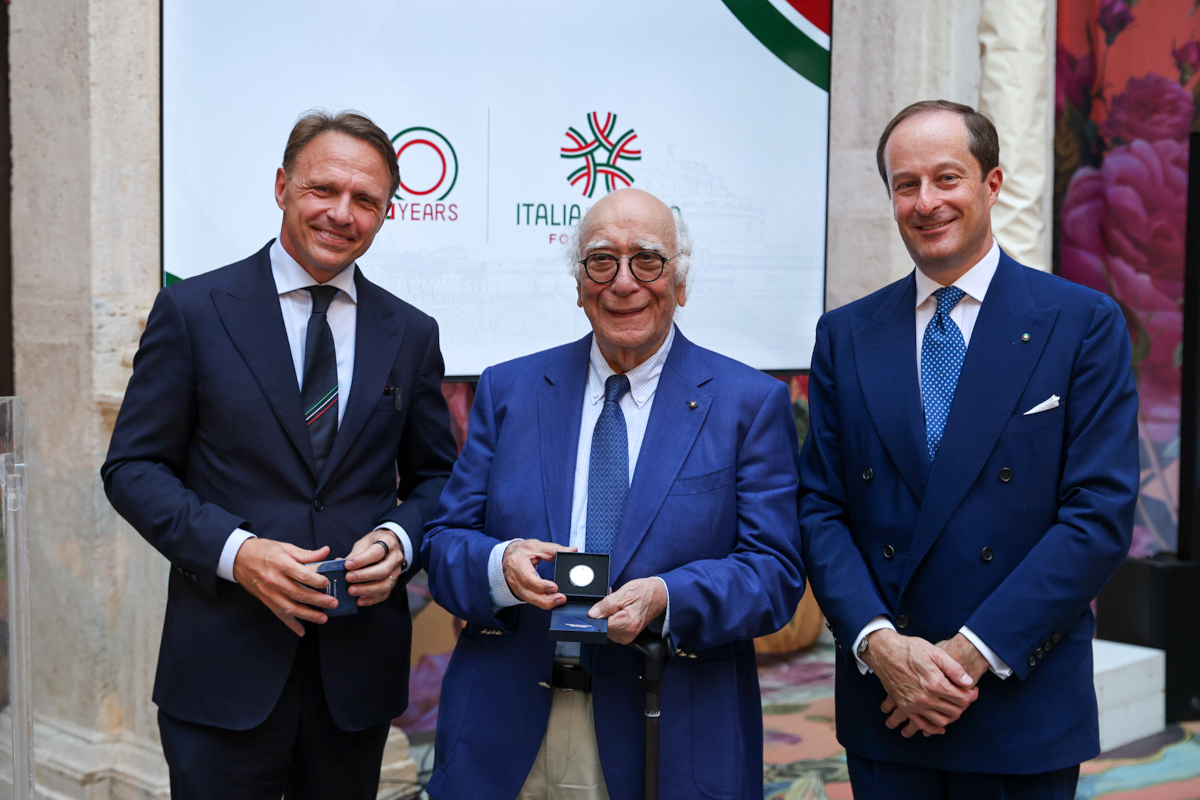
During the event, Minister Lollobrigida presented Giovanni Rana, founder and honorary President of Italia del Gusto, with the commemorative coin dedicated to Italian Cuisine’s UNESCO Heritage recognition, honoring an entrepreneurial legacy built on family values, quality, and the global promotion of Italian traditions.
Industry leaders highlight resilience and collaboration
“We have a resilient system capable of addressing every commercial and geopolitical challenge in the right way, as Italians who know how to succeed under the most difficult conditions,” said the Italian Agriculture Minister Francesco Lollobrigida. He added that distinctiveness remains a defining characteristic of Italy’s business model. Lollobrigida further stressed the uniqueness of Italian entrepreneurship, stating that “distinctiveness is the hallmark of our business system, where the entrepreneur is also the pater familias of the company, solving management challenges and protecting its reputation.”
Giovanni Rana highlighted the growth of Italia del Gusto over the past two decades, noting that the consortium’s aggregated turnover has increased from €5 billion to €35 billion. He said the group’s strength lies in the sharing of ideas and collaboration among members. Despite international uncertainties, Rana expressed confidence in future growth, commenting: “We are doing well because we export food, and Italian food is loved all over the world.”
Giacomo Ponti, Chairman of Italia del Gusto, said: “Over the past twenty years, Italia del Gusto has demonstrated that working together is not only an organizational choice but also a strategic lever for competing and growing in international markets. The ability to combine different experiences, skills, and visions has enabled member companies to expand their business abroad and strengthen the position of Made in Italy worldwide.” Ponti added: “The strength of Made in Italy today lies in its ability to present itself cohesively in foreign markets while enhancing identity, quality and innovation.”
Global market trends remain uneven
According to data from the Nomisma Observatory for Italia del Gusto, global GDP is expected to grow by 3.3% in 2025, although economic performance is becoming increasingly uneven across regions. Emerging economies continue to drive growth, while the Eurozone shows a weaker and more fragmented profile. Inflation trends remain heterogeneous, with advanced economies experiencing greater normalization while several emerging markets continue to face significant price pressures.
Food and beverage consumption patterns are also diverging. In emerging markets, particularly India and China, per-capita food consumption increased by 26% between 2019 and 2024, significantly outperforming mature economies.
Italian food exports reach €59.3B
Italian agrifood exports reached €59.3 billion in 2025, confirming Italy’s position as the world’s sixth-largest exporter and accounting for 4.6% of global sector trade. Exports grew by 5.1% in 2025 despite increasing market polarization and diverging regional performances.
Europe remained the primary growth driver, with exports rising 7.3%, while the United States represented the main exception among key destination markets. Italian food exports to the U.S. declined by 4.5%, reflecting the negative impact of tariffs.
Global food trade remains highly concentrated, with the United States, Germany, China, the United Kingdom, and France accounting for approximately three-quarters of global demand.
France and Germany continue to be among the markets most closely linked to Italian food products, with 9.9% and 9.3% respectively of their food and beverage imports sourced from Italy. Among monitored markets, Japan stood out as one of the leading economies for premium food products and among the countries with the highest per-capita food expenditure. Poland and Spain delivered some of the strongest growth performances, with Italian food exports rising 21.6% and 13% respectively, while demand softened in several traditional export destinations.
Competitive strength in key categories
Italian F&B producers continue to maintain strong competitiveness in several strategic segments of the global food market, including coffee, baked goods, chocolate and cheese. Twenty years after its foundation, Italia del Gusto continues to demonstrate the effectiveness of a collaborative growth model. As global competition intensifies, industry leaders emphasized that cooperation, innovation, and the promotion of Italian excellence will remain central to sustaining the international competitiveness of Italy’s agrifood sector.