According to the latest Trade Data Monitor analysis, Japan’s agri-food trade balance remained structurally negative over 2016–2025, reflecting growing reliance on imported food and beverages.
As a result, Japan’s agri-food trade deficit widened steadily. After hovering between –¥5.7 trillion and –¥6.3 trillion in 2016–2019, the deficit narrowed temporarily in 2020 (–¥5.7 trillion) due to weakened domestic demand, before expanding sharply from 2022 onward, exceeding ¥8 trillion and reaching approximately –¥8.8 trillion in 2025. In this context, Japan remains an open and receptive market for foreign agri-food products, particularly in higher value-added segments, albeit with growing sensitivity to pricing.
ITALY–JAPAN TRADE: STRONG GROWTH, STRUCTURAL IMBALANCE
Trade relations between Italy and Japan show steady medium-term growth but remain structurally unbalanced in Italy’s favor. Japanese imports of Italian food and beverages expanded from ¥102 billion to ¥170 billion, marking an overall increase of approximately 67%. Japan’s trade deficit with Italy widened from –¥100 billion in 2016 to a peak of –¥172 billion in 2024, before partially narrowing to –¥165 billion in 2025. This trend reflects growing Japanese demand for Italian products, particularly in premium segments, alongside the limited penetration of Japanese goods in the Italian market.
The analysis points to a strongly asymmetric relationship in which Japan represents a key outlet for Italian agri-food exports while the reverse flow remains marginal. Growth is closely tied to premium positioning, with rising demand for authentic, geographically indicated, and high-image products. At the same time, recent fluctuations highlight sensitivity to macroeconomic variables such as exchange rates and imported inflation, which affect value dynamics more than volumes.
PREMIUM SEGMENTS DRIVE PERFORMANCE
Between January and November 2025, Italian exports of food and beverages to Japan reached €861 million, placing the country 16th among destination markets with a 1.4% share. Japan thus remains a mid-sized but strategically important market, thanks to its high purchasing power, strong orientation toward quality, and its role as a showcase for premium Made in Italy products in Asia. Over the longer term, exports grew from approximately €789 million in 2015 to a peak of €1.005 billion in 2024, confirming a positive trajectory.
The composition of exports reveals a strong concentration in traditional Made in Italy categories. Processed fruit and vegetables account for 18.3% of total exports, while pasta and bakery products stand at 14%, oils and fats at 13.4%, and dairy products at 12.7%, with smaller shares distributed among other processed foods, cocoa-based products, and oilseeds. This structure reflects a clear specialization in high-value-added products with strong territorial identity.

Exports are concentrated in key items. In the first eleven months of 2025, extra virgin olive oil reached €95 million (–21.4%), pasta €75 million (–7.2%), preserved tomatoes €49 million (–9.5%), chocolate products €26 million (+22.8%), fresh mozzarella €24 million (–26.0%), processed tomatoes €24 million (–16.6%), PDO cheeses such as PDO Grana Padano and Parmigiano Reggiano €22 million (+9.0%), sweet bakery products €19 million (+33.2%), and fresh cheeses €17 million (+99.6%).
Growth is particularly strong in premium and high perceived-value segments such as PDO cheeses, confectionery, and chocolate, while declines are concentrated in traditional, price-sensitive categories such as olive oil and tomato preserves. At the same time, the overall strengthening of high-quality dairy products is evident.
REGIONAL EXPORT LANDSCAPE
The geographical distribution of Italian exports to Japan shows a strong concentration in a limited number of regions. Campania leads with €121.3 million (17.9%, –10.8%), followed by Lombardy with €112.7 million (16.6%, –6.6%), and Emilia-Romagna with €106.1 million (15.7%, –10.1%), together accounting for half of total exports.
STRATEGIC OUTLOOK: PREMIUM POSITIONING IS KEY
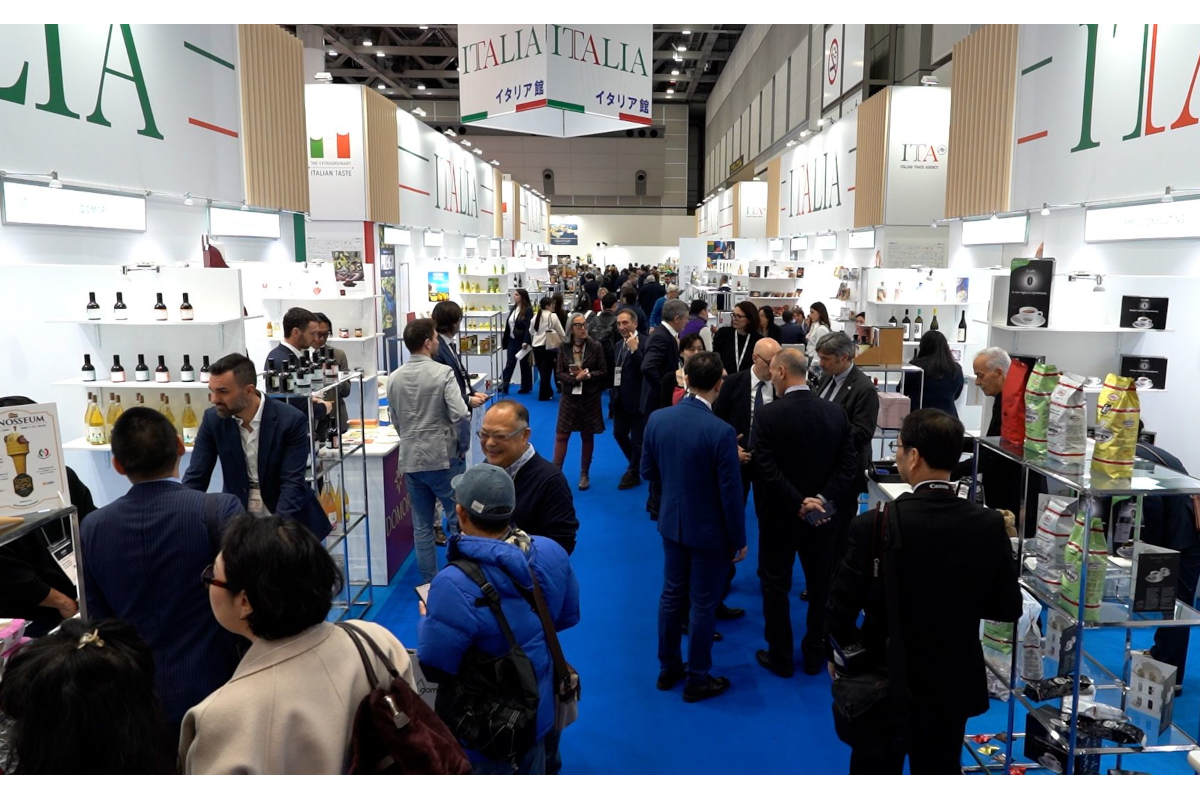
Japan continues to rank among the most sophisticated and high-value markets for Italian agri-food, but 2025 marks a shift from broad-based expansion to increasing demand selectivity. The strong Italian presence at the Foodex Japan 2026 trade show, with around 250 companies led by the Italian Trade Agency, confirmed the strategic importance of this market and the effectiveness of integrated promotional models combining product display with experiential and cultural storytelling, particularly in engaging buyers and Horeca operators.
Overall, the Japanese market appears to be entering a more mature phase in which growth is no longer primarily volume-driven but depends on the ability to consistently occupy premium segments, interpret a highly sophisticated demand, and deliver value aligned with the positioning of Made in Italy.
According to the Italian Trade Agency analysis, Japan remains a structurally solid and strategically important destination, offering long-term growth potential for companies capable of maintaining strong differentiation in quality, authenticity, and perceived value.